
Your shoulders carry a tension that never quite releases.
You scan the room without meaning to – checking exits, reading faces, monitoring tone.
And rest doesn’t restore you the way it used to.
Your mind knows you’re safe, but your body? Your body hasn’t caught up yet.
If this sounds familiar, you’re not alone. And more importantly, you’re not broken. What you’re experiencing is your nervous system staying in protection mode, responding to a threat that has already passed.
It’s not a disorder. It’s not a weakness. It’s your body doing exactly what it was trained to do: keep you alive.
What Survival Mode Actually Means
Survival mode is what happens when your nervous system’s threat response stays switched on long after the danger has ended.
Your autonomic nervous system has two main gears.
- Sympathetic activation powers fight and flight—the racing heart, the surge of energy, the readiness to move now.
- Dorsal vagal activation brings freeze and shutdown—the numbness, the fog, the collapse inward when fighting or fleeing aren’t options.
Both responses are brilliant, really. They’re survival strategies that kept you safe when you needed them most.
The challenge? Your nervous system doesn’t always know when to switch off. If the threat lasted long enough, or came often enough, your body learned to stay ready. It assumes the world is still unsafe, even when your rational mind knows otherwise.
Your body did its job. It kept you alive. It just hasn’t realised the war is over.

How It Shows Up: The Signs Your Body Hasn’t Caught Up
These are signals with your body speaking in the only language it knows.
Not character flaws. Not even the beliefs that are attached. And definitely not things you need to power through – or can think your way through.
You’re Always Scanning
Hypervigilance hums quietly in the background of everything you do.
You check exits without thinking. You monitor tone, read faces, track mood shifts in the room. Your shoulders stay tight. Your jaw clenches. Your breath never quite deepens.
You probably don’t even notice you’re doing it anymore. It’s become normal to be on guard.
Even when nothing is wrong, your body assumes it probably is. It’s waiting. Watching. Preparing for something you can’t name.
You Can’t Rest, Even When You’re Exhausted
You’re tired, but you’re also wired. Sleep doesn’t restore you. Your mind won’t quiet, even when you lie down. Thoughts loop. Plans form. Worries stack like plates you’re trying not to drop.
Rest can feel unsafe when your nervous system believes staying alert is what keeps you alive. So you push through. You keep going. And the exhaustion deepens, because your body never gets permission to fully let go.
You’re Numb or Shut Down
Sometimes survival doesn’t look like panic. Sometimes it looks like nothing at all.
You move through your day. You function. But you feel flat. Disconnected. Like you’re watching your life happen rather than living it.
This is freeze—what happens when fight and flight aren’t possible, and your nervous system pulls you inward to protect you from overwhelm. You’re here, but you’re not really here. Emotions are muted. Sensation is dulled. The body becomes a place you’ve learned to leave.
When you keep turning up to work, doing what you’re ‘supposed’ to do, you may well be living in ‘functional freeze’.

Small Things Feel Huge
A tone of voice. A delay in a text reply. A change in plans.
And suddenly, you’re flooded.
Your nervous system doesn’t know the difference between a raised voice and real danger. When survival mode is your baseline, small stressors can feel like emergencies. You go from zero to one hundred in seconds, and it doesn’t feel proportional—but to your body, it is. Because your body is still responding to an old threat, not the present moment.
This isn’t overreacting. This is a nervous system doing what it was trained to do.
You’re Overthinking Everything
Your mind spins, plans, anticipates. If you can think far enough ahead, predict enough outcomes, prepare for every possibility—maybe then you’ll be safe.
Rumination is another form of hypervigilance. Mental scanning instead of physical. It’s exhausting, and it doesn’t work, but your nervous system keeps trying anyway. Because once upon a time, staying one step ahead helped you survive.
Your Body Holds the Evidence
Digestive issues that doctors can’t quite explain. Chronic tension in your neck, your back, your jaw. Headaches. Fatigue that rest doesn’t touch.
These aren’t separate problems. They’re part of the same picture.
Trauma sits in our body. The body holds what the mind tries to forget. When your nervous system stays in survival mode, your body pays the cost—tension that never releases, systems that can’t settle, energy that never restores.
This is where somatic therapy becomes important. Because healing happens through the body, not around it.
Why Your Nervous System Gets Stuck
Survival mode doesn’t require a single catastrophic event. It forms when your nervous system learns that the world isn’t safe, and that lesson went on long enough to become your baseline.
Maybe it was childhood. Maybe it was a relationship. Maybe it was years of chronic stress, caregiving, or living in an environment where you couldn’t let your guard down.
Maybe it was grief, or loss, or simply too much for too long with no space to process.
Your nervous system doesn’t measure trauma by how “bad” the event was. It measures by what your body needed to survive—and whether it ever got the signal that it could stop.
This isn’t a weakness. This is a nervous system that learns to keep you alive.

The Gap Between Knowing and Feeling Safe
Here’s the difficult truth: you can’t think your way out of survival mode.
Your mind can know you’re safe now. You can rationalise, remind yourself, list all the evidence. But your body speaks a different language—the language of sensation, breath, tension, and release.
Safety isn’t an idea. It’s a felt experience.
And if your nervous system hasn’t felt safe—if it’s only been told about it—it will keep protecting you the only way it knows how.
Regulation happens through the body, not just the mind. It happens through breath. Through presence. Through attuned connection. Through gentle, consistent signals that it’s okay to rest.
Your body needs to feel safe, not just know it.
What Your Nervous System Needs
Healing a nervous system that’s been in survival mode for a long time doesn’t happen overnight. It happens in small moments. In pauses. In breaths. In the space between one response and the next.
Your nervous system needs gentle, consistent signals of safety. Not pressure. Not force. Not urgency.
Just presence. Time. The permission to move at your own pace.
It needs regulation before insight. You don’t need to understand everything before you begin. You just need to help your body remember what it feels like to soften.
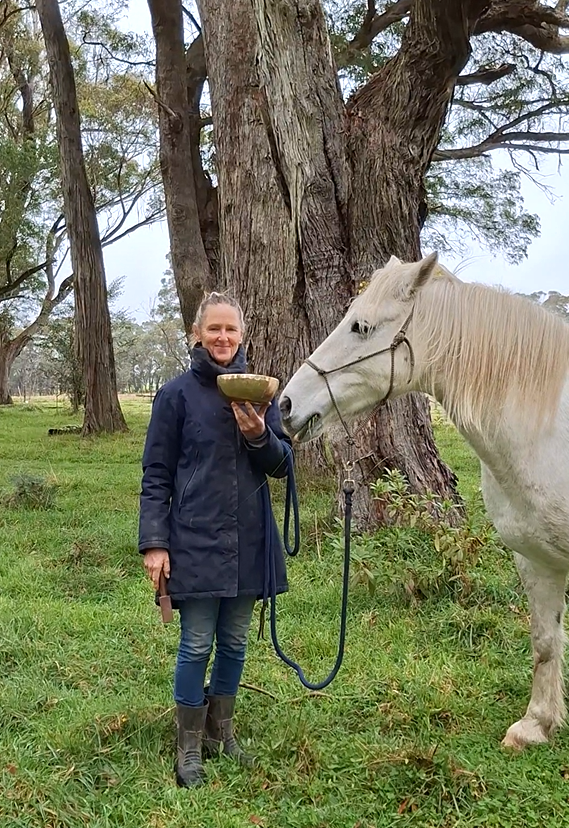
This can happen through nature. Through grounded, attuned presence. Through co-regulation with another nervous system—a person, a horse, the land itself. Through slowing down enough to notice what’s here, right now, in this breath.
Sometimes it helps to step away from the noise entirely. To give your nervous system the space it needs to recalibrate—somewhere quiet, somewhere held, somewhere your body can begin to remember what rest actually feels like.
Healing isn’t about fixing. It’s about helping your body remember it’s allowed to rest.
Recognising these signs is the first step. Not so you can diagnose yourself, or add another label, but so you can begin to understand what your body has been trying to tell you.
Your nervous system isn’t broken.
It’s been working so hard to keep you safe. And now, with time and space and the right kind of support, it can learn that the threat has passed.
Healing is possible. And it begins with listening.