
You may have read, or overheard, something about a life experience not being ‘bad enough’, or ‘big enough’, to have an ongoing effect on you.
Maybe it was an article. Perhaps something a friend forwarded without comment.
Or possibly something you saw when you were just scrolling online.
Something in it landed.
Something hit home. Resonated.
The description of never quite switching off.
The apologising.
The way rest feels like something you have to earn before you are allowed to have it.
And then you did what most people do. You went looking for the reason.
You ran back through your childhood, checking it against what you had just read, looking for the event that would explain why you are the way you are. Something that would give you permission to take this seriously.
And you did not find one.
No violence.
No crisis.
No addicted parents.
Nobody walked out.
There was food on the table every day, and a bed at night.
And people who, by any reasonable measure, loved you.
You know for a fact that your parents did their best with what they had.
So you closed the tab. Maybe this isn’t true for you. Other people have real reasons.
So why then had it stopped you in your tracks?

The audit we all run
There is a thing people do before they let themselves ask for support.
We line our history against everyone else’s, and we go looking for the moment that would justify how we feel.
Someone we know had it worse.
Someone in the news certainly did.
Against that, the ordinaryness of our own upbringing looks like nothing worth mentioning.
The trouble is that comparison is a very poor instrument for this. It measures events. It cannot measure what an experience did inside a small nervous system that had nowhere else to go.
A child does not weigh their circumstances against the general population.
They simply adapt to the one home they have.
What was missing, rather than what happened
Here is the part that the audit never catches.
You have been searching for something that happened.
It may be that what shaped you is something that did not.
Nobody asked how you were … and then waited long enough for the real answer.
The argument stopped, and the house went quiet, and nothing was ever repaired afterwards. It was simply over, and you were expected to be over it too.
You were welcome when you were cheerful and easier to be around, and left more alone when you were not.
Your feelings were managed rather than met. Tidied away rather than made room for.
None of that is an event.
There is no scene to recall, no anniversary, nothing you could describe to someone at a dinner party without it sounding like a complaint about very little.
This is what we call ‘little t’ traumas. Those small, almost missable things that happened on repeat, and usually through our formative years.
This is what shaped us every day.
They are what shaped our nervous system, and created our beliefs – that then drive us from the depths of the unconscious.
And this is what goes unnoticed for twenty, thirty, forty, fifty years …

The body files it anyway
Your nervous system was never checking whether an experience qualified.
It was doing something far simpler and far more intelligent. It was noticing what was reliably true, over and over, and adapting so that you could stay safe and stay connected to the people you depended on.
If being useful was how you stayed close to someone, your body learned to be useful.
If needing something led to disappointment, your body learned not to need it.
If nobody came when you were upset, your body learned to manage alone.
These were not flaws in your character. They were good decisions, made early, by a system doing its job well.
Many of the signs your nervous system is stuck in survival mode began as exactly this kind of intelligent survival adaptation.
The difficulty is not that the adaptation happened.
The challenge is that it is still running, decades after the conditions changed.
Guests here at Highlands Centre For Healing often share that they don’t feel their voice is strong enough, that they can speak up or out when there’s a need to.
Some feel uncomfortable in their relationship, but don’t know how to even begin discussion with their partner as they don’t understand themselves for starters.
Others have gone through life feeling they don’t belong. They are too different. Nobody can understand the complicated being they are.
What it looks like now
You may recognise some of this. You may recognise none of it, and that is fine too.
Rest that feels like something to be earned, and guilt if you take it before the list is finished.
Apologising before you have worked out what for.
Compliments that land somewhere awkward and need deflecting.
Saying yes with your mouth while something much louder inside you is saying no.
Needing that glass of wine.
Reading the mood of a room before you have taken your coat off, and adjusting yourself to it without ever deciding to.
Being the one who always copes. The one others turn to with an expectant expression.
None of this is a test, and there is no score at the end of it. It is not a list to measure yourself against and then decide whether you are entitled to feel. It is simply a few descriptions, offered in case any of it sounds familiar.
Support is available for all of us, in a huge variety of ways. We just have to find the courage to start seeking what will suit our needs. This might be your GP, a mental health professional, a bereavement counsellor, a therapist or healer. A best friend. Nobody knows what will work for you except you – and often we have to try one or more things before we find a good fit.

You do not have to tick certain boxes
You are allowed to want something different.
You do not need a worse story.
You do not need to have been through more in order to earn attention, or rest, or support, or an afternoon where nothing is asked of you.
The idea that support is a limited resource, and that taking any of it means depriving someone who needs it more, is itself worth noticing. For many people, that thought is not a considered position. It is the adaptation, still running.
Nobody is going to check your reasons for wanting change..
Where this can go
If the mind could resolve this on its own, it would have done so already.
Most people have understood their own patterns for years, sometimes with real insight.
And have found that the understanding changed remarkably little about how they actually feel.
Or how they continue to show up in life.
That gap between knowing and feeling is where this work begins.
It is the territory of trauma healing, a body-led journey back to yourself, where the body is allowed to lead, and the understanding is permitted to arrive in its own time, rather than the other way around.
It is often more gradual than people expect. There is no requirement to retell your story – and in fact, this is counter productive and may retraumatise.
For a great many people, the words were never where the thing was stored in the first place.
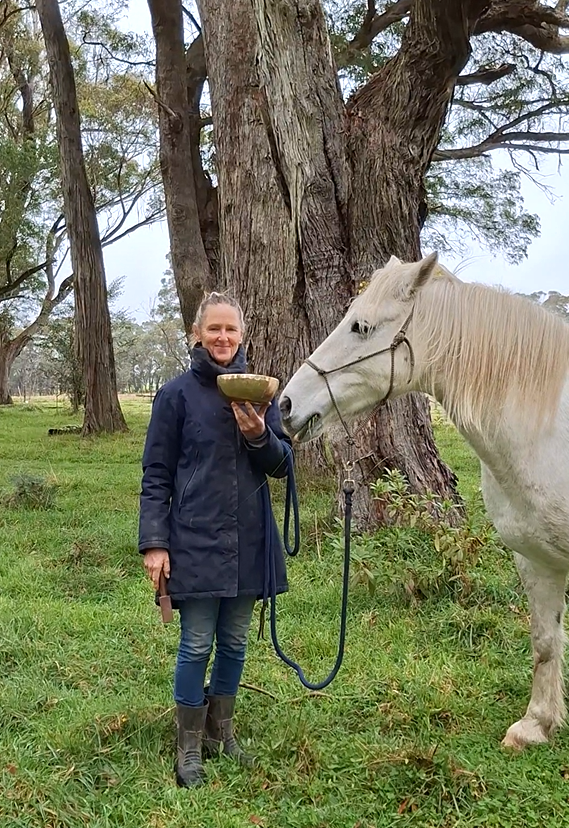
At HCFH much of the work happens outdoors, with the herd nearby.
Horses respond to what is actually going on in a person energetically,rather than to the account that person gives of themselves.
They have no interest at all in whether your reasons are good enough, and no way of being impressed by how well you are managing.
People notice the calm, the scents of the trees, and the supportive energy as soon as they drive through the front gates.
This starts the journey of inner discovery. And is critically important.
We cannot start out on an adventure without being properly equipped.
And to do this internal work, we must start with a sense of safety, of calm, of being regulated.
The horses meet us as we show up. , Some find this slightly disarming.
Quite simply, they react and respond to the energy of our thoughts, words and feelings.
And they are lightning quick in their responses.
They can draw awareness to parts of us that we forgot decades ago.
You do not have to arrive with the story ready, or explain yourself well, or get it right on the day. There is no right or wrong. We are all unique individuals carrying our own backpacks of life experience, showing up how life has trained us to do.
And at any given moment, when we make the choice, we can change that.
A gentler conclusion
Go back to that evening, and the article, and the tab you closed.
You were not wrong to recognise yourself in it. You were only wrong about needing to prove it first.
Nothing about you needs fixing. Something in you learned, a long time ago and for good reason, how to manage without. That can soften. Not through insight alone, and not through effort, but through enough experiences of safety that the body starts to believe them.
You are welcome here, exactly as you are, with whatever reasons you have or do not have.