
Your body is wise. It is not broken. Even the parts of you that feel chaotic, or embarrassing, or frustrating, the parts that react before you have time to think, those parts are not evidence that something is wrong with you. They are evidence that something in you has been working very hard to keep you safe.
That is what a trauma response is.
A trauma response is your nervous system’s automatic reaction to perceived danger. It moves faster than thought, based on what your body learned in the past about how to survive. The four most recognised trauma responses are fight, flight, freeze, and fawn, with two quieter patterns (attach and collapse) that many people recognise themselves in too.
What A Trauma Response Actually Is
TRAUMA sits in our body. This is why you cannot think, rationalise, or talk your way out of it.
A trauma response is an instinctive reaction to perceived danger. It happens faster than thought. It does not check in with your conscious mind. It moves on old information, stored deep in the nervous system, from a time when your body needed to protect you in whatever way it could.
Sometimes the danger is happening right now. More often, the body is reading something in the present (a tone of voice, a certain silence, a smell, a look) that reminds it of a time when you were not safe. It does not wait for you to catch up. It just moves.
This is survival intelligence, not malfunction. Your body remembers so you donot have to.

Why Your Body Chose This Response
Our autonomic (or automatic) nervous system governs how we respond to stress. It has a part that revs up when it senses threat, and a part that settles us when the threat has passed.
In everyday stress, the rev goes up, and then it comes back down. We return to coherence. The body breathes, softens, digests again.
With trauma, the system can get stuck on. The stress response stays switched on long after the original traumatic event has passed. Small things become triggers. You are easily thrown into arousal, or into shutdown, or into behaviours you do not fully understand. You might manifest physical and emotional symptoms that do not seem connected: the tight shoulders, the clenched jaw, the racing heart, the numb feeling that will not lift, the cry that will not come.
What you are experiencing is not WHOyou are. It is what your being has done to keep you alive.
The Four Most Common Trauma Response Types
You may have heard of the four Fs. Fight, flight, freeze, and fawn. These are the four most recognised trauma response types. Most of us move between them depending on the situation, the relationship, and the day. None of them are character flaws.
Fight
The fight response is the body bracing to defend. Anger. Irritability. Defensiveness. Aggression. An argument that flares up from nowhere. Underneath it is almost always fear.
A fight response is not the same as a bad temper. It is the nervous system choosing confrontation because something in the past learned that was the way through. The body floods with energy. Jaw tightens. Chest braces. You feel the heat.
I have sat with people whose first instinct in any hard conversation is to push back, hard. Underneath that force, when things go quiet enough, there is almost always a very young part of them that once had nobody pushing back on their behalf.
Flight
The flight response involves moving away. Literally leaving the room, or quietly leaving yourself(disassociation). This is the response that shows up as avoidance. The phone call you keep not making. The conversation you keep not having. The constant busyness that keeps you a step ahead of what hurts.
Flight can also look like overworking, scrolling, drinking, training too hard, keeping every moment of the day full.
In the body, flight often feels like restlessness. A buzzing. A need to keep moving. A sense that stillness is unbearable.
Freeze
The freeze response is the body going still. You might feel stuck. Numb. Disconnected from the room and from yourself. You might find you cannot speak, cannot move, cannot think clearly. Time slows. Later you replay the scene and wonder why you did not do, or say, the thing.
Deer in the headlights. Chest collapsed a little. Breath shallow. Hands cold. Part of you somewhere else.
Freeze is what the body does when neither fight nor flight feels possible. It is the response of a system that learned, at some point, that the only way through was to go quiet and wait. If you have been misread as lazy, avoidant, or cold, and known underneath that it was not the truth of you, this may be why.
Fawn
The fawn response is the body appeasing. It is the least talked about of the four, and often the quietest.
A fawn response looks like over-apologising, over-explaining, over-giving. It looks like reading the room constantly. It looks like saying yes when everything in you wanted to say no. It looks like keeping the peace at a cost you rarely let yourself count.
In the body, fawn often lives in the throat and the jaw. A tightness around speaking up. A permanent low-grade effort to be whatever the other person needs. Over time, the fawn response involves a steady, invisible exhaustion that most people around you will not see.
Fawn is often mistaken for kindness. It is not. Kindness comes from a settled nervous system that has a choice. The fawn response comes from a nervous system that once learned safety only came through appeasement.
I say this gently, because I know how much shame can live inside this one.
Two Less-Known Trauma Responses: Attach And Collapse
The four Fs are not the whole picture. There are two other patterns many recognise themselves in.
Attach (Cry For Help)
Before a child can fight or run, they can only reach out. The attach response is the nervous system searching for co-regulation. In adults, it can show up as an urgent need for connection when we are stressed, a deep pull to find someone who can help us feel safe, difficulty being alone when something is hurting.
This is not neediness. It is a body that was wired to heal in relationship, reaching for what it was designed to receive.
Collapse (Shutdown)
When a threat has gone on long enough, or when the body has decided no other response will work, the system can drop into shutdown. This goes deeper than freeze. It can feel like exhaustion that sleep will not touch. A flattening. A disconnect that is hard to describe to anyone who has not been inside it.
Collapse is sometimes read as depression. Sometimes it is. Sometimes it is a very tired nervous system that has been running protection for a long time, finally having to rest.
How These Responses Show Up In Everyday Life
Trauma responses do not only appear in crisis. They live in the small, quiet corners of daily life.
You might pick fights with the people who get closest to you. You might disappear a little when a relationship starts to matter. You might feel most like yourself in conflict, and most unsettled in calm. You might be exhausted from a week of subtle people-pleasing and not know why.
At work, it can look like hypervigilance in meetings, perfectionism that will not let you finish anything, or sudden paralysis when a task feels too big. You might work past what your body can hold. You might struggle to delegate because depending on anyone feels unsafe.
Your body will often carry the story before you have words for it. Tight shoulders. Clenched jaw. Gut that churns without reason. Sleep that will not settle. A startle response that never quite turns off. Physical pain with no clear source. Fatigue that rest does not touch.
And in the quiet, a silent voice can appear that tells you something is wrong with you. You are too much. You are not enough. You are broken. You are unlovable.
Please hear this. That voice is not the truth of you. It is the echo of what happened, and how you made sense of it when you were trying to survive. You do not need to argue with it. You just need to stop believing it speaks for you.
How Trauma Responses Begin To Shift
Insight alone will not heal your nervous system. You can understand exactly why you freeze, or fawn, or fly, and still find yourself doing it next week. This is how the body works, not how you have failed.
Healing from trauma happens at the level the response lives at. Which is the body.
We Heal In Relationship
The nervous system learned its responses in relationship, which is where it also heals. We are not built to cope with trauma alone. We regulate by borrowing another regulated nervous system until our own can do more of the work itself.
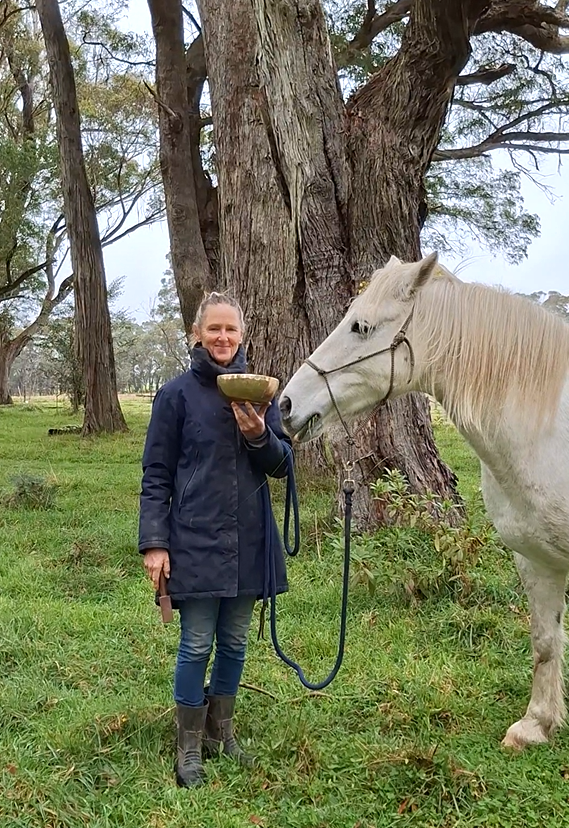
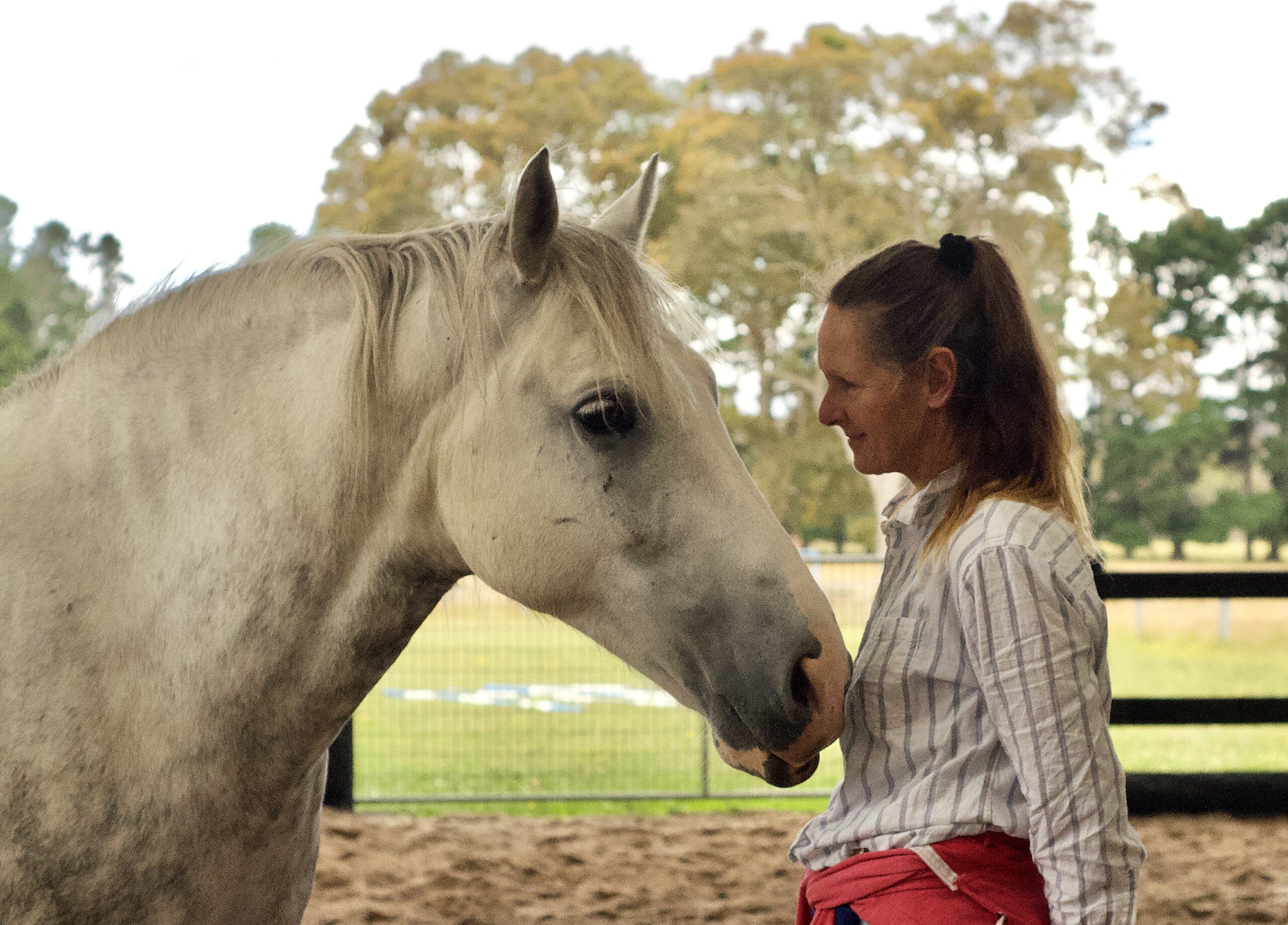
That other nervous system does not have to be human. It can be a good dog. A place that has held you before. A trusted friend who knows how to sit with you without trying to fix. A horse standing quietly nearby.
You do not have to process your trauma alone. And you were never meant to.
Noticing The Body, Before The Words Come
Before you can talk about a trauma response, you need to be able to feel one. Slow work. Paced work. Catching the tightness before it becomes a reaction. Catching the collapse before it takes the day. Small, patient, embodied attention to what the body is telling you, in a setting gentle enough for the body to trust.
This is where somatic healing quietly begins.

Nature, Horses, And The Land
I am deeply connected to this land and to the animals who share it. Together they shape the way I work.
There is a reason why being near horses, or in a forest, or beside water, can soften something in the body that talking has not been able to reach. The natural world moves at a pace the modern one does not. Horses in particular are exquisitely attuned. Their nervous systems read ours before we have finished noticing what we feel. When you stand near a horse that feels safe, your body receives a signal it rarely gets from another person.
This is close to the heart of the work at Highlands Centre for Healing, where sessions are ground-based, horse-assisted, and held in nature. Emerging research is beginning to support what people have known for a long time: that time with animals and land can support trauma recovery in ways that reach below language.
When Professional Support Helps
Therapy is not the only path, but for many it is an important one. Therapeutic approaches that work directly with the body, such as somatic experiencing, trauma-focused CBT, and EMDR (eye movement desensitization and reprocessing), can help the nervous system reprocess what got stuck. For some people, these cognitive and body-based approaches used together reach further than either alone.
If your trauma response is disrupting your daily life, or if you have been diagnosed with a stress disorder or PTSD, working with a trauma-informed practitioner can make a real difference. Group therapy can also hold space for people who have found healing in being witnessed by others. Your mental health matters, and the right kind of support, offered at the right pace, can be part of the journey.
There is no single right path. There is only the path that meets you where you are.
A Gentle Closing
Understanding trauma responses gives you language for what your body has been doing all along. It takes some of the shame out of behaviours that used to make no sense. It lets you see yourself more clearly, and more kindly.
But understanding is only the beginning. The real work happens slowly. In the body. In safety. ith support.
There is no deadline on any of this. There is no right way. There is no comparison. Your responses are not evidence that you are broken. They are evidence that your nervous system has been in survival mode.
You are not broken. Nothing needs fixing.
When you are ready to gently unpack and begin to work with what your body has been carrying, we are here. Soo, the horses, the land. No hurry. No performance. Just the kind of space a tired nervous system can begin to settle into.
If this is calling you, we would love you to join us when the time feels right.
Common Questions
What is a trauma response?
A trauma response is an instinctive, automatic reaction the nervous system uses to protect us from perceived danger. It can involve fight, flight, freeze, fawn, attach, or collapse, and it often stays switched on long after the original traumatic event has passed.
What are the four types of trauma responses?
The four most recognised trauma response types are fight (bracing to defend), flight (moving away), freeze (going still), and fawn (appeasing to stay safe). Most people move between them depending on the situation.
What are the 7 trauma responses people talk about?
Some practitioners expand the four Fs by adding quieter patterns the body can drop into. At Highlands Centre for Healing, the two most often recognised alongside fight, flight, freeze, and fawn are attached (the nervous system reaching for co-regulation) and collapse (a deeper shutdown beyond freeze). Others include fright, flag, or faint, which describe variations of immobility and surrender.
Can trauma responses be healed?
Yes. Trauma responses can soften and shift over time, especially through body-based and relational approaches such as somatic experiencing, EMDR, trauma-informed therapy, co-regulation with a safe person, and time in nature. Healing is not linear, and there is no single right path.