
You slept eight hours. You took the weekend off. You cancelled the thing you didn’t have the energy for. And you still woke up tired.
Not the kind of tired a nap fixes. Something deeper. It sits behind your eyes and across your shoulders and somewhere in your chest, and it doesn’t seem to care how much you rest.
If that sounds familiar, you are not lazy and there is nothing wrong with you. Your body is doing something far more intelligent than failing. It is staying ready.
Rest and safety are not the same thing
We tend to think of rest as something we schedule. A lie-in. A holiday. An early night. Those things matter. But rest only restores us when the body underneath believes it is safe to hit pause.
For a lot of people, this is hard to experience
You can be lying completely still, phone away, lights low, and your nervous system can still be quietly scanning. Listening for the next thing that needs handling. On the outside you may think you are resting… but underneath you are actually still on duty.
This is the part most tiredness advice misses. It treats exhaustion as a shortage of sleep, a lack of nutrition, when often it is a shortage of safety.

What your body is actually doing
You have an old, deep system whose only job is to keep you alive. It reads your surroundings constantly, far below conscious thought, and decides moment to moment whether you can soften or whether you need to stay alert.
When life has asked a lot of you for a long time, that system can learn to stay switched on. Not because anything is broken in you, but because staying ready once helped. The body remembers what kept it safe, and it keeps offering you the same protection long after the original need has passed.
So you carry a low hum of alertness everywhere you go. Into sleep. Into the weekend. Into the moments that are meant to be calm. Holding that much readiness, every hour of every day, wears you down in a way no amount of lying down can reach.
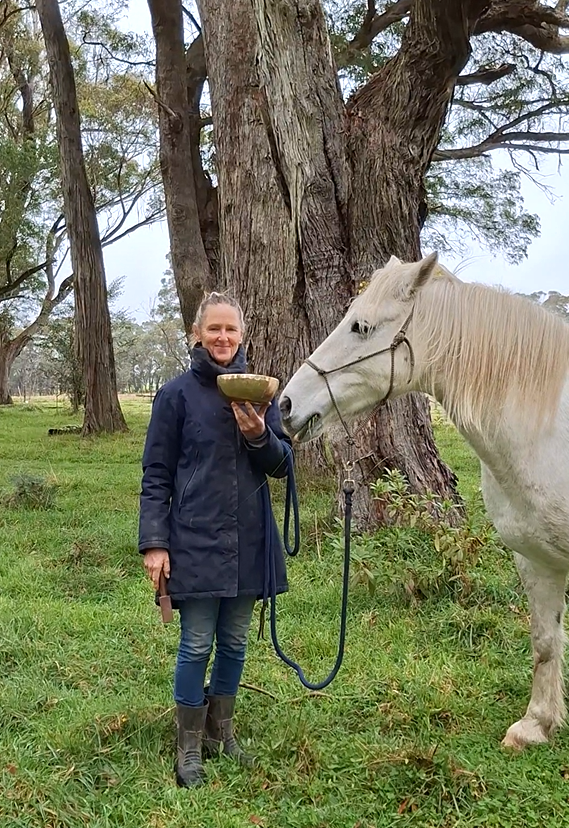
I see this often in the people who come to be with the horses. The horses themselves are a quiet teacher here. They rest completely when it’s safe to, and they rouse in an instant when it isn’t, then they let it go and settle again. Most of us have forgotten that second part. We rouse – and then we stay roused.
The cost of always being the capable one
The people who feel this most are often the ones who look like they are coping best.
The ones everyone leans on. The carers, the organisers, the steady ones who quietly hold things together. Capable on the outside, running on empty underneath, and unable to work out why.
If you have spent years being the person who manages and anticipates and keeps things from falling apart, your nervous system has been on shift for a very long time. That capability becomes a kind of armour. Useful, sometimes admirable, and slowly depleting all the same.
You can be genuinely competent and genuinely tired at once. That isn’t a contradiction. Most of the time, the two grew up together.
When numbness gets mistaken for rest
Sometimes the body can’t hold high alert any longer, so it does something else. It turns everything down.
This can feel like flatness. Going through the motions. Being there without quite being present. People describe it as fog, or numbness, or watching their own life from a step behind.
From the outside it can look like rest, and at first it might even feel like relief. But it isn’t the same as settling. It’s another form of protection, the body lowering the volume so you can keep going when you have been carrying too much for too long.
Real rest feels different. There’s warmth in it. A loosening, rather than a switching off.
Why pushing harder doesn’t work
When rest doesn’t refill us, the instinct is to try harder at resting. More discipline. More sleep tracking. Stricter rules about screens and bedtimes and morning routines.
Those things might help a little. But you cannot discipline a nervous system into feeling safe. Safety is not a task you complete. It is a STATE the body has to be gently allowed back into, usually slowly, and usually in the company of something that already feels steady.
This is why telling yourself to relax so rarely works. The body doesn’t respond to instruction. It responds to cues, to pace, to places and people that stop asking anything of it for a while. It responds to breath.

What helps the body settle
There is no quick fix here, and anyone promising one is worth a raised eyebrow. But there are conditions that make it easier for the body to come down from high alert.
A real drop in pace is one. Not collapse, but a slowness where nothing is being chased.
Co-regulation is another, and it matters more than most people realise. Our bodies settle most easily near other bodies that are already settled. This is true of calm people, and it is true of animals. Standing near a horse who is grazing, unbothered and unhurried, your own breathing tends to lengthen without you deciding to do anything at all.
Nature does quiet work too. Open space, weather, the absence of demand. Something in the body recognises it and begins to unclench.
And then there is being met without pressure. Being somewhere you don’t have to perform or explain or hold anything together, where you are allowed to arrive at whatever pace you actually arrive in. None of this forces a result. It simply offers the body enough genuine safety to start putting down what it has been carrying.
A gentler way to understand your tiredness
If you take one thing from this, let it be that your exhaustion makes sense.
It is not a character flaw or a willpower problem. It is the honest result of a body that has been staying ready for a long time, often without you noticing. That readiness kept you going. Now it is asking for something sleep alone cannot give: safety, slowness, and spaces that let your system know it can finally stop bracing.
Healing here isn’t about fixing what’s wrong with you, because nothing is wrong with you. It is about slowly teaching your body that it is allowed to rest, properly, all the way down. That kind of rest is possible. It just tends to begin somewhere quieter than the calendar.
At Highlands Centre for Healing, much of our work comes back to this: helping the nervous system find its way toward safety, gently and at your own pace, alongside the horses and the land. If something here felt familiar, you’re welcome to learn more about how we work.