
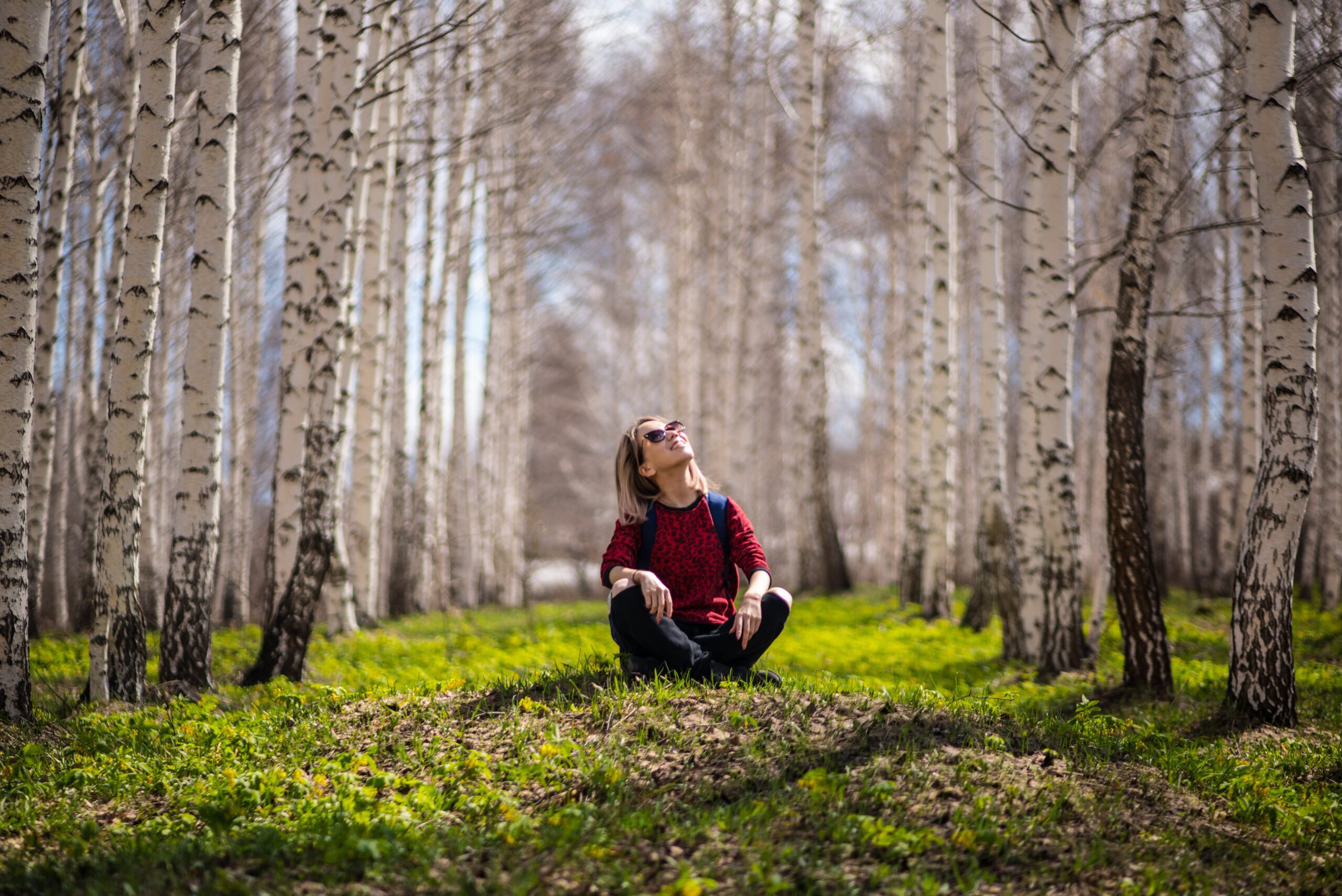
Stand still outside for long enough and something in you starts to loosen. You may not notice it happening. But your shoulders drop half an inch. Your breath goes a little deeper. The noise in your head, the one that never quite stops indoors, gets some space around it.
This is not a mood. It is your physiology, doing something it has done for longer than any of us have been alive.
Many of us spend our days indoors now, mostly under artificial light, looking at screens that were designed to hold our attention rather than settle it. It is no wonder so many people arrive here feeling wired and depleted at the same time. The body was not built for that much stimulation with so little contact with the natural world it evolved inside.
Why time outdoors is not a luxury
When you step outside, and stay a while, your nervous system begins to shift out of alert mode. This is not vague wellness talk.
Research on time in nature has found that as little as twenty to thirty minutes outdoors can lower the stress hormone cortisol by more than twenty percent, and practices like forest bathing show measurable activation of the parasympathetic nervous system, the “rest and digest” state your body needs in order to actually repair itself (Frontiers in Psychology, on cortisol and nature exposure).
Your blood pressure eases. Digestion, which shuts down under stress, gets permission to work properly again. The part of your brain that has been scanning for threats all day finally gets to stand down.
None of this requires effort or technique. It happens simply because you are there, and your body remembers what to do.
What this land does, specifically
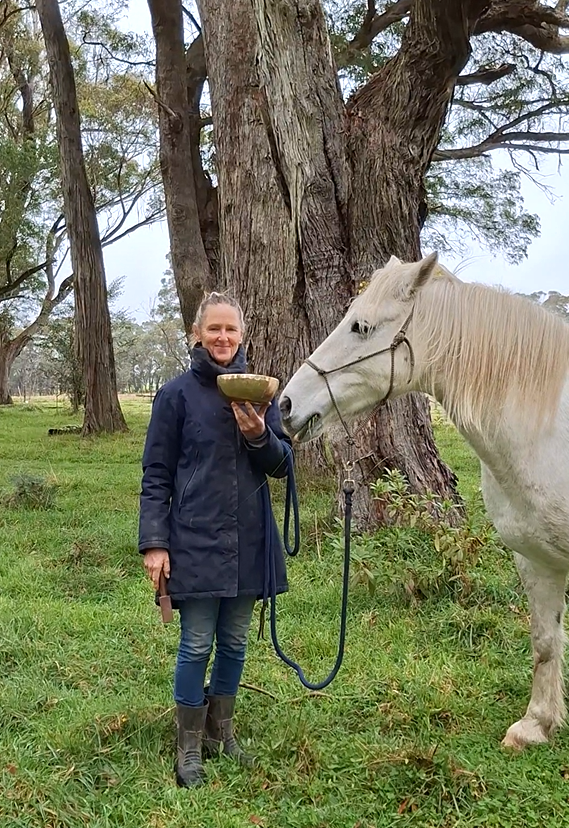
We are fortunate here. 106 acres in the Southern Highlands, Gundungurra Country, with paddocks, trees, dams, and a herd of horses who have nowhere else to be and nothing to prove. Wildlife, birds, fresh air.
There is a particular quality to this kind of quiet that a suburban park does not quite reach. No traffic. No notifications. Birdsong instead of background noise. The smell of grass and rain and horse. When people arrive here carrying the tight, bright tension of the drive up from Sydney or Canberra, we watch it happen, often within the first hour. The shoulders come down. The voice softens. The pace of speech slows to match the pace of the place.
That is not something we engineer. It is simply what this land does to a nervous system that has been asked to run too fast for too long, in the same way long-term overwork asks a body to override its own limits until it forgets how to stop.
Nature as company for what you are carrying
There is also something nature offers that indoor healing spaces cannot quite replicate: it does not need anything from you.
A tree does not need you to explain yourself. A horse grazing nearby is not waiting for you to perform wellness. There is a kind of safety in being witnessed by something that asks nothing in return, and for people who have spent years attuning to everyone else’s needs, that safety can be its own form of relief.
This is why our work happens outdoors rather than in a consulting room. Trauma and chronic stress live in the body, not only in the mind, and a body that has been guarded for a long time often finds it easier to soften in an environment that feels genuinely safe than in one that simply says it is.
Emerging research increasingly treats time in nature as a legitimate support for nervous system regulation and trauma recovery, alongside, not instead of, professional care (Convenient Counseling Services on nature and trauma recovery).
We do not promise that nature heals everything, and we would not trust anyone who did. But what we have seen, again and again, is that it makes healing more possible. It lowers the noise enough for the real work, whatever that looks like for you, to actually land.
Letting nature in, without a checklist
You do not need equipment or a technique for this. Mostly, you need to actually arrive.
Put the phone somewhere you cannot see it, even for twenty minutes. Let your senses do what they already know how to do, the colour of the light, the sound of wind moving through trees, the smell after rain. Walk slowly enough that your body, not your schedule, sets the pace.
And choose somewhere that genuinely settles you, rather than somewhere that photographs well.
If your mind is loud and your body feels far away, simple mindfulness practices can help you arrive in a place before you expect it to do anything for you. Presence tends to come first. Everything else follows from there.
Nurtured by nature, and by the herd
This is why the work here happens the way it does. Not in a clinical room with fluorescent light, but outdoors, with horses who reflect back exactly what is present in you, and land that has been holding people long before we arrived to steward it.
If you have been living at a pace that has taken you further and further from your own body, our nature-based retreats offer a different pace entirely. Not an escape from your life, but a chance to remember what your nervous system feels like when it is finally allowed to settle.
There is no itinerary that rushes you. There is just the land, the horses, and the time it takes for your body to believe it is safe to slow down.
Frequently asked questions
How long does it take to feel the benefits of time in nature?
Research suggests measurable drops in stress hormones after twenty to thirty minutes outdoors, though the deeper settling that comes with feeling safe in a place often builds over longer, repeated time. There is no single dose. Even short, regular time outside adds up.
Can nature really help with trauma or chronic stress?
Time in nature supports nervous system regulation and can make other healing work, including therapy, more effective. It is not a replacement for professional care, but a genuine complement to it, particularly for a body that has been guarded for a long time.
Do I need to do anything specific outdoors for it to help?
No. The nervous system responds to simply being present in a natural environment. Putting your phone away and letting your senses lead is enough. Structured activity can help, but presence matters more than technique.
This article is for general information and reflection. It is not medical advice and is not a substitute for care from a qualified health professional.
About the Highlands Centre for Healing
We offer holistic wellbeing for mind, body and soul bringing together a range of alternative, complementary wellbeing practices united by one single intention – to help you heal and find wellness. Join us for community or corporate group programs, workshops and retreats, or private equine therapy experiences.