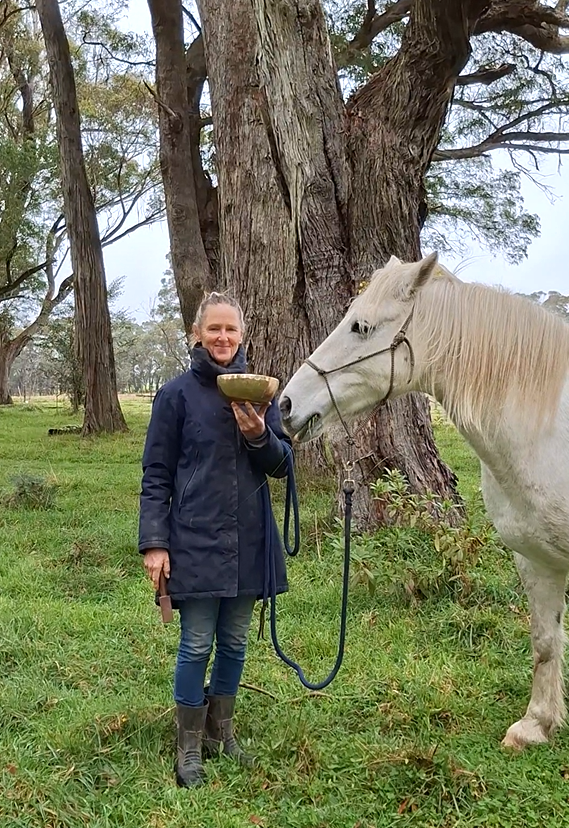

Your body has been speaking to you since the beginning of life.
Not in the dramatic language of pain or crisis, not yet, but in whispers.
A tightness in your throat when certain conversations begin.
The way your digestion shuts down before big meetings.
How your voice becomes thin and breathy when you’re overwhelmed, even though you’re “fine.”
The chronic tension between your shoulder blades that no amount of massage can release.
These aren’t random inconveniences. They’re not signs that you’re ageing poorly or that something is fundamentally wrong with you. They’re signals from your nervous system, carried through the vagus nerve, attempting to tell you that your system doesn’t feel safe.
And most of us have learned to ignore them entirely.
The Body’s Quiet Intelligence
The vagus nerve is one of the primary pathways through which your brain and body communicate. It runs through the face, throat, heart, lungs, and digestive tract, linking your inner world with your physical state.
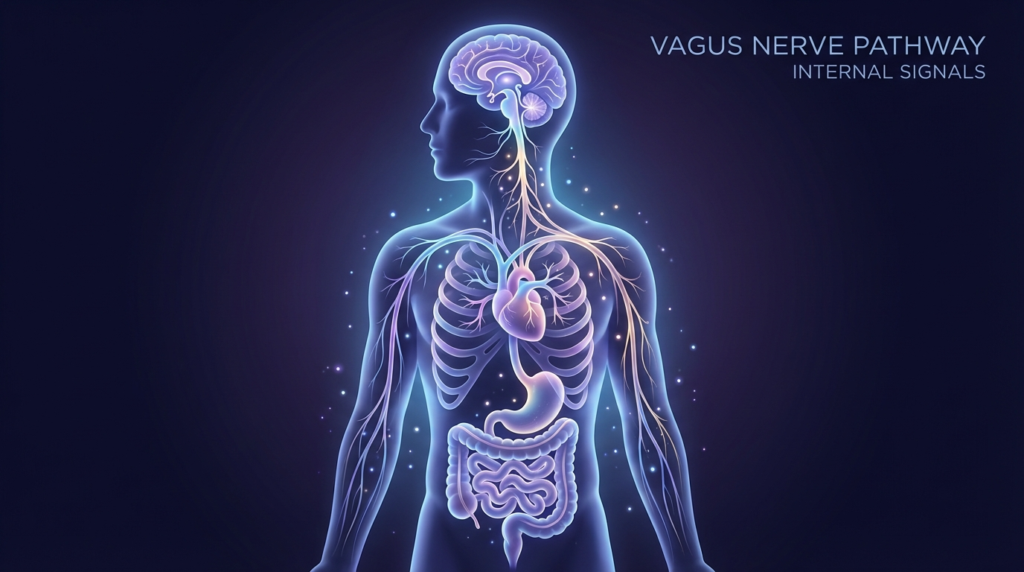
Your nervous system is constantly scanning for cues of safety or danger, often beneath conscious awareness. A harsh tone of voice, a facial expression, a crowded room, the quality of light, even your own internal state can all shape how your body responds. When safety is present, the body can settle into connection, digestion, restoration, and healing. When threat is perceived, protective responses take over: mobilization, or shutdown.
The symptoms we label as “dysfunction” are often your nervous system functioning exactly as designed.
It’s not broken. It’s doing precisely what it evolved to do when safety signals are absent.
The question isn’t “What’s wrong with my vagus nerve?”
The question is: “What has my nervous system been trying to tell me that I haven’t been able to hear?”
The Signals We’ve Been Trained to Dismiss
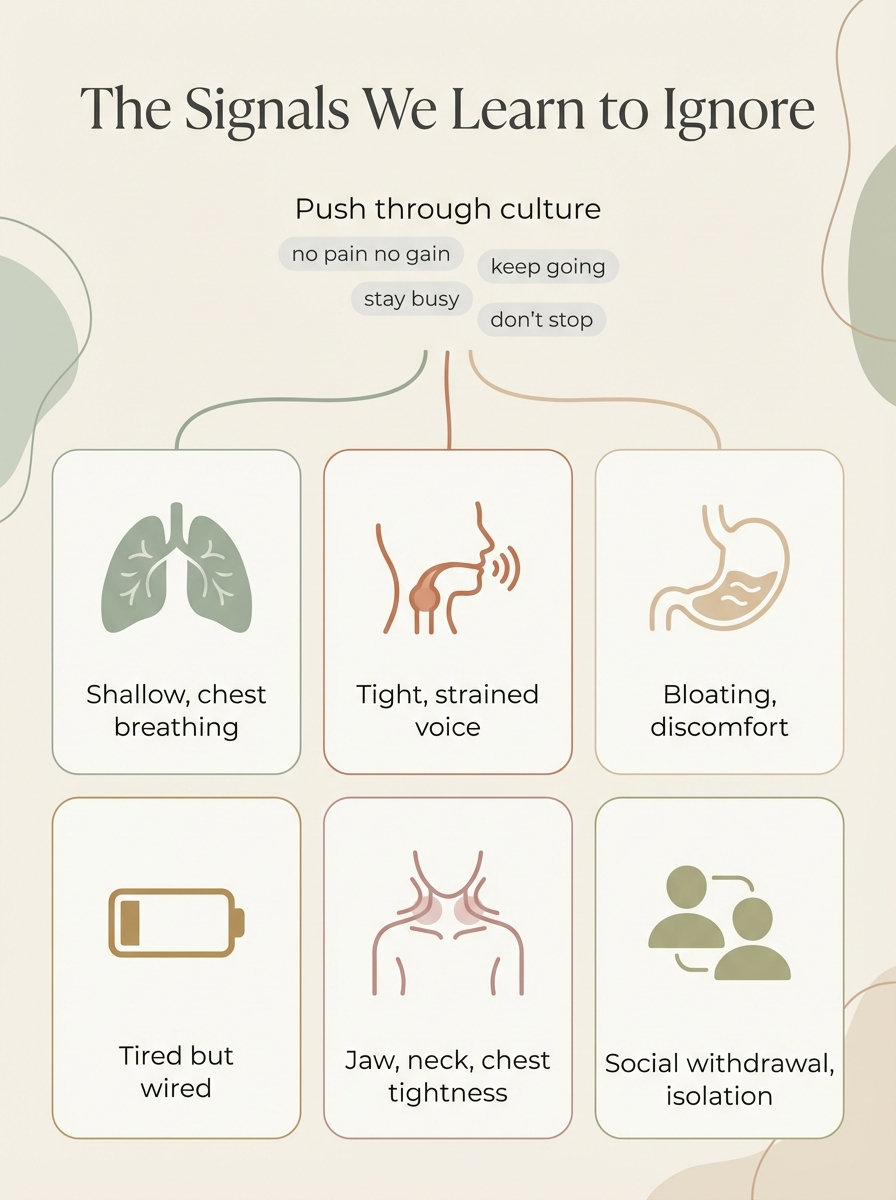
We live in a culture that celebrates pushing through. Mind over matter. No pain, no gain. Keep going. Don’t stop. And in that relentless forward momentum, we’ve become fluent in the language of ignoring.
When Your Breath Becomes Shallow
Notice how you’re breathing right now. Are you chest breathing, taking short, shallow inhales that barely expand your ribcage? Most people are.
Shallow breathing isn’t a cause of nervous system dysregulation. It’s often a symptom. When your vagus nerve perceives threat, the body prioritises survival over rest. You might notice this happening while scrolling social media, opening your inbox, anticipating a difficult conversation, or simply sitting at your desk.
The subtlety is that you’ve probably been breathing this way for so long that it feels normal. You don’t notice until someone points it out, or until you find yourself sighing repeatedly, an unconscious attempt to regulate.
When Your Voice Changes Quality
Have you ever noticed how your voice becomes higher, tighter, or loses its resonance when you’re stressed? The vagus nerve innervates your vocal cords and larynx. When your nervous system shifts into protection, your voice often changes with it.
Some people develop chronic throat clearing. Others find their voice seems to disappear in certain situations, not from shyness, but because speaking itself no longer feels supported. You might also experience a persistent lump sensation in your throat that no medical test can explain.
Some traditions describe this as a blocked throat. Modern neuroscience might recognise it as a reflection of vagal dysregulation.
The whisper is often there long before any obvious voice issue appears. Your voice loses fullness, warmth, or steadiness in certain contexts, and your body is already telling a story.
When Digestion Becomes Unreliable
Your vagus nerve plays a major role in parasympathetic function, including digestion. When you’re in a stress response, digestion slows. Blood flow shifts away from the gut and toward the muscles.
Early signals can include bloating after meals that used to feel fine, inconsistent appetite, nausea or butterflies unrelated to food quality, or bowel patterns that become unpredictable.
Many people spend years trying to manage digestive symptoms through diet changes, elimination protocols, and supplements, all of which can be helpful, without recognising the nervous system component.
Your gut may not be broken. It may be responding to a body that doesn’t yet feel safe.
When Your Energy Flatlines Without Reason
There’s the fatigue that comes from illness, overwork, or lack of sleep.
And then there’s the exhaustion that comes from a nervous system running threat-detection patterns all day, every day.
This kind of fatigue doesn’t necessarily improve with rest, because it isn’t only about sleep. It’s about a system that never fully shifts into restoration, where repair, immune support, and energy recovery can actually happen.
You might wake tired no matter how long you’ve slept. You might feel wired and exhausted at the same time. You might find it hard to recover from illness, stress, or exercise.
This isn’t just burnout in the conventional sense. It’s your system using more energy than it can restore because, somewhere underneath, it still believes you’re not safe.
When Your Body Holds Tension in Predictable Places
Chronic neck and shoulder tension. Jaw clenching. A tight chest. Low back pain that has no obvious structural cause.
These symptoms are often treated as separate physical issues, but they can also reflect a nervous system in chronic protection. When your body prepares for fight or flight, certain muscle groups engage. The shoulders rise. The jaw tightens. The neck braces.
The whisper stage is often more subtle. You notice tension arising in specific environments, around certain people, or during particular internal states, long before it settles into chronic pain.
When Social Situations Drain You Disproportionately
Polyvagal theory describes a social engagement system that supports eye contact, connection, and ease in relationship. When this pathway is available, connection feels nourishing. Conversation flows. You leave interactions feeling steady or enlivened.
When your nervous system is in defence, social engagement can become effortful or even overwhelming. You might avoid eye contact without knowing why. Feel drained after ordinary conversations. Prefer text over phone calls. Feel relief when alone, but also a painful sense of isolation.
This isn’t always introversion.
Introverts can still access social engagement. They simply need more solitude to recharge. Nervous system dysregulation makes connection itself feel physiologically demanding.

The Anatomy of Ignoring
Why do we miss these signals?
Because they’re inconvenient. Because we’ve been taught that the body’s needs are obstacles to productivity. Because acknowledging them might require us to change something, and change can feel threatening to a nervous system already braced for danger.
So we develop sophisticated ways of overriding the body’s communication.
- Caffeine to push through fatigue.
- Alcohol to force relaxation.
- Constant activity to avoid feeling.
- Perfectionism to create an illusion of safety through control.
- People-pleasing to reduce the risk of relational threat.
Each strategy may offer temporary relief while quietly teaching your nervous system that the internal environment can’t be trusted.
And eventually, the body stops whispering and starts demanding to be heard.
Learning to Listen Again
Here’s the paradox: you can’t think your way into nervous system regulation. The vagus nerve operates beneath conscious control, responding to actual cues of safety rather than concepts of safety.
But you can begin to notice what your body is already telling you.
Not as something to get right, but simply as a way to begin reconnecting.
Throughout your day, you might pause and ask:
- How am I breathing right now?
- Where am I holding tension?
- What’s the quality of my voice?
- How does my digestion feel?
- What’s my energy state?
Don’t try to fix anything at first. Just notice.
This kind of noticing begins to rebuild interoception, your ability to sense and stay connected to your inner state.
And over time, patterns start to emerge.
When do these signals intensify? Around which people, places, tasks, or internal states?
Your nervous system isn’t random. It’s responding to specific cues. Understanding those patterns can begin to reveal what your system has learned to interpret as threatening.
You can tell yourself “I’m fine” while your body is registering something very different. Cognitive reassurance only goes so far. The nervous system responds most deeply to lived experiences of safety, not just thoughts about safety.
What Actually Helps
This isn’t an article prescribing ten ways to stimulate your vagus nerve. You may already have tried humming, cold exposure, or breathing exercises. They can be supportive, but they are rarely the whole picture.
Regulation happens in relationship. The nervous system develops in relationship, and very often heals in relationship too.
That might look like therapy that works somatically rather than only cognitively. It might mean environments that offer rhythm, attunement, predictability, and safety. It might mean time in nature, connection with animals, or experiences of co-regulation with other grounded nervous systems.
This is the work we do at Highlands Centre for Healing.
Through somatic energy healing, equine-assisted therapy, and Reiki With The Herd, the work speaks directly to the nervous system through presence, attunement, and the co-regulating wisdom of horses.
Horses act as vagal tone biofeedback in real time. They respond to your internal state with remarkable accuracy, not to your words, but to what your body is actually holding. And they do so without judgment, offering the kind of presence that can help your system remember what safety feels like.
The Invitation
Your body has been trying to get your attention. Not because something is wrong with you, but because your nervous system is wise enough to signal when it needs support.
Those subtle symptoms, the ones you’ve been dismissing as stress, ageing, or personal weakness, are invitations.
Your vagus nerve is asking: Can we slow down enough to notice what’s happening? Can we create conditions where safety is possible? Can we learn a different way of being in the world that doesn’t require constant vigilance?
The whispers are still quiet. You have time to listen before they become shouts.
About Soo
Soo Woods is a counsellor, somatic practitioner, and energy healer at Highlands Centre for Healing in the NSW Southern Highlands. Her work weaves together nervous system support, equine-assisted therapy, and the grounded presence of a 106-acre nature sanctuary.
If you’re ready to listen more closely to what your body has been trying to tell you, you can explore the retreat offerings or reach out for a conversation about what support might feel most aligned.