

Someone asks how you are doing now. There is a small emphasis on the now, and you hear what sits underneath it. They are asking whether you are through it yet.
You say you are getting there. It is easier than explaining that last Tuesday you were fine in the supermarket until you saw the biscuits they liked, and you had to stand very still in aisle four until the intensity of the pain passed.
Nothing has gone wrong. You have not slipped backwards. What you are meeting is the difference between the schedule other people imagine grief runs to, and the way it actually moves through the body.
The timeline was never real
Most of us absorbed the idea that grief has stages, and that the stages run in order, and that somewhere near the end of them is a place called acceptance where the whole thing is finished.
That was never what the model said.
The five stages came from Elisabeth Kübler-Ross’s work with people who were dying, and were only later adapted to the experience of the bereaved. Her own collaborator, David Kessler, is direct about how they were meant to be read: they are not stops on some linear timeline in grief.
Somewhere between the research and the everyday, a description of what some people notice turned into a schedule everybody was expected to keep. It is worth naming how much quiet harm that has done.
Australia’s own health guidance says something much closer to what you are living. The Victorian Government’s Better Health Channel puts it plainly: grief does not have a timeline, and most of us go on grieving in subtle ways for the rest of our lives, even while we are getting on with things.
So if you have been measuring yourself against a calendar, you have been holding yourself to something that was never true.

What your body is actually doing
Grief is not only an emotional event. It is also a physical one. It arrives in the chest and the throat and the stomach. It changes your sleep, your appetite, your sense of time. It takes your concentration and does not ask first.
And it may not arrive all at oncet. A body will not open to more than it can hold. That is not avoidance, and it is not weakness. It is somatic intelligence doing exactly what it evolved to do, which is to let something in at the rate you can survive it. The body knows what it has room for, long before the mind has an opinion about it.
Healthdirect describes grief as coming in waves, fading in intensity for a while before returning. That is the shape of it. Not a line from one end to the other, but a tide.
The part that catches people out is the returning. When a wave arrives eight months, or three years in, the mind reads it as evidence of going backwards. The body is doing something quite different. It is bringing you the next piece now that there is room for it.
Why it comes back when it does
Some waves are obvious. Anniversaries, birthdays, the first Christmas, the second Christmas. Better Health Channel notes that these upsurges are often strongest around exactly those dates.
Others arrive with no warning at all. A voice on the phone that sounds like theirs for half a second. The smell of a particular soap. Their handwriting on the back of something you were about to throw out.
There is also a quieter pattern, and it is the one that tends to make the most sense to people once it is named. Grief often waits for capacity. It waits until the funeral is over, the paperwork is done, the people have gone home and you are no longer holding everyone else together. Then, when you finally have somewhere to put it down, your body brings it.
Which means the wave that arrives when things are calmer is not a setback. It is often the first moment your system has judged safe enough.
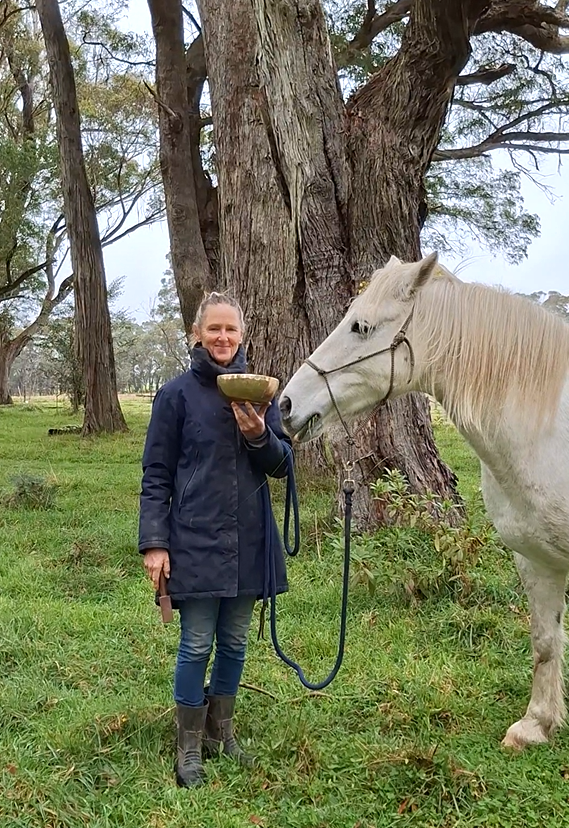
Soo Woods sees this shift in people who come to Highlands Centre for Healing in the weeks and months after a loss. She is careful not to assume what someone is feeling from the outside, because only they can truly know what is happening internally. But there is one change she sees often.
“The biggest thing, regardless of the timeframe, is the look of relief. Their face softens, their shoulders lower, when I tell them that what they are going through is completely normal.”
Sometimes that reassurance is the first thing that loosens the belief that grief should already look different. The pain has not disappeared. Nothing has been solved. But the person no longer has to carry the additional fear that they are doing grief incorrectly.

What tends to help when a wave arrives
Our best advice is not to try and resolve it. Not to ignore it.
If you are able to, hit pause. Allow the wave to increase in intensity, and the observer in you become present to it, watching as it peaks before starting to reduce in size.
Breathe slowly.. One breath at a time is genuinely enough. Putting your focus on your breath helps.
Let your body move if it wants to move. Walking, weeping, standing in a paddock doing nothing in particular. The body carries grief physically, and it tends to release it physically too. This is part of why nature medicine matters so much in this work. Our nervous systems evolved outdoors, and they settle there in a way they rarely manage indoors under artificial lights.
And let yourself be witnessed. Not advised, not cheered up, not helped to move along. Simply accompanied by someone who is not waiting for you to be finished. Indigenous wisdom often appoints a person to accompany the griever for as long as is needed. Someone who holds space, watches over them, keeps them safe.
Nothing needs fixing here. Grief is not a fault in the system, and you are not broken for still being in it. It is love trying to find a way to express itself t.
Somewhere to be with it
If you are grieving now and want company in it, Soo runs Circle of Comfort, a small grief counselling support group at The Stables here at Highlands Centre for Healing in Moss Vale.
It meets fortnightly on Wednesdays, 10.30am to 12 noon. It is $33 a person, or $56 for two people with the discount code TWO. There is a cuppa, gentle ground-based time with the horses if that feels right, and nobody will ask you to explain your loss. You can find the next Circle of Comfort session here.
If what you are carrying sits deeper in the body than words reach, that is often where body-led trauma healing begins.
And if your questions are about death itself rather than grief support, the practical and human things most of us were never given any language for, there are two one-off sessions with Angela Mizinska, a Death Doula and Death Literacy Educator.
You Don’t Know What You Don’t Know runs Saturday 31 October, 10am to 12.30pm, $115 per person. Dying to Talk, a relaxed Death Cafe-style conversation, runs Saturday 5 December, 10am to 12.30pm, $115 per person. Both include time with the herd. These are not grief counselling and they are not a support group. They are a chance to ask the questions you have never had anywhere to ask.
Soo Woods is a registered, qualified counsellor and trauma-trained somatic practitioner, and has sat with a great many people in the middle of this.
You do not have to be further along than you are.
FAQs
How long does grief last?
There is no set length, and Australian health guidance says so directly. Some people describe the sharpest part easing over months, others over years, and most people find that grief keeps returning in quieter forms for the rest of their lives. None of those is the wrong answer.
Why does grief come back after I thought I was doing better?
Because grief moves in waves rather than in a line. A wave arriving later often means your body finally has the capacity to feel something it could not hold earlier, particularly once the immediate demands have settled. Feeling it again is not the same as going backwards.
Why do anniversaries and birthdays hit so hard?
Dates carry memory in the body as much as in the mind. Anniversaries, birthdays and holidays are among the most common times for grief to surge, and it can begin days or weeks before the date itself, often before you have consciously registered what is coming.
Is it normal to feel grief physically?
Yes. Tightness in the chest and throat, heaviness, exhaustion, disrupted sleep, appetite changes and difficulty concentrating are all commonly described. If anything about your health is worrying you, it is always worth raising with your GP.
Am I grieving wrong if I do not feel the stages?
No. The stages were drawn from work with people who were dying, later adapted to bereavement, and were never intended as a sequence to complete. Many people never recognise them at all.
What actually helps when a wave arrives?
Usually presence rather than solutions. Slowness, breath, movement, time outdoors, and someone willing to sit with you without needing you to be finished. Being witnessed does something that advice cannot.