
You are, by most measures, doing amazingly.
People rely on you. You get things done. If someone asked, you would say your life is good, and you would mean it.
And yet there is still a quiet, steady sense that you are falling short of something. You could not name the standard if I asked you to. You only feel that you have never quite met it.
This feeling is something that many people (often women) carry. It is something you learned, usually very early, before you had words to question it. It arrived as a conclusion, not as a fact, and then it stayed so long that it started to feel like a personality trait.

The rules we learned before we could question them
Nobody sat you down and told you the rules of survival, existence.
You may have learned that it was safer not to take up too much space. That being useful was the surest way to be wanted. That being easy, being no trouble, kept the air in the room calm.
You may have learned that love was something you earned – rather than something you received automatically
These are not the sort of lessons anyone teaches deliberately.
They are absorbed, in a thousand small moments, the way a child absorbs a language. And like a first language, you do not experience them as something you learned. You experience them as simply how things are.
How a rule becomes a belief
A child does not have the option of concluding that the adults around them are struggling, or tired, or carrying something of their own. That thought, if it were possible, would be too dangerous, because those adults are the whole world. So the child asks a different question, and it is the only question that really matters to them.
What do I need to be, so that this stays alright?
Whatever answer comes back becomes a rule. Be quiet. Be good. Be helpful. Do not need much. The rule works, in the sense that it helps them stay connected to the people they cannot survive without. And because it works, it stays.
Then it does something else. It becomes a filter.
Researchers who study early attachment describe this as an internal working model, a set of expectations built from experience that then shapes how everything afterwards is interpreted. In one review of that work, the authors describe these models becoming the lens through which children reconstruct new experiences in ways that stay consistent with what they already expect.
Think about what that means over twenty, thirty, forty+ years.
If you learned early that you were a bit much, then every ambiguous silence since has been read as confirmation. Someone takes a day to reply and you know why. A friend seems distracted and you run back through the conversation looking for what you did, or said. Nothing has to actually happen. The filter finds the evidence on its own, and each time it does, the belief gets a little more solid.
All this time you have been carrying a way of reading the world.

When nothing happened at all
A lot of people stop themselves here, because their childhood was ‘fine’.
No shouting. No crisis. Nothing you could point to.
This matters because it is easy to miss. It is not only what happened that shapes a person, it is also what did not.
The question that was never asked. The answer nobody waited around for. The argument that stopped, but was never repaired.
The comfort that came only when you had already gone quiet.
There is a well known piece of infant research that documents this. When a caregiver stays physically present but stops responding, keeping their face still, babies become distressed. They try to get the interaction back, and when they cannot, they turn away. A meta-analysis drawing on eighty-five studies found the effect held steady across very different groups of infants and different versions of the experiment.
That is laboratory research with babies, and I do not want to stretch it further than it goes. But it tells us that the expectation of being responded to is there right from the beginning.
Which means the absence of a response was never nothing. It was information.
If you would like the wider picture of how experience shapes a nervous system, Understanding Trauma covers that ground.
‘Normal’ isn’t always healthy
These patterns become durable because they get praised.
Never asking for help reads as strength. Working past the point of exhaustion reads as commitment. Being the calm one in a crisis reads as maturity. Anticipating what everyone needs before they ask reads as thoughtfulness, and people are genuinely grateful for it.
Behaviour that is rewarded is almost never examined.
So the adaptation survives, decade after decade, wrapped in compliments. You are the reliable one. You are so capable. I do not know how you do it. And underneath, quietly, the same old rule keeps running, which is that this is what you have to do in order to be alright with people.
I see variations of this in the people who come here. Not people in crisis. Competent, generous, capable people who are very tired and cannot work out why, because on paper nothing is wrong.
If that sounds familiar, keeping busy may be a trauma response looks at one version of it closely.
Things you thought were just part of who you are
I thought I was just sensitive.
I thought I was lazy.
I thought I was a people pleaser, and that it was a character flaw I should be able to talk myself out of.
I thought I was someone who did not need much.
Perhaps none of those were ever your personality.
What you have been calling sensitivity may be a nervous system that learned to read a room very early, because reading a room accurately once mattered a great deal.
The laziness might be a body that worked out, a long time ago, that starting something is where the risk lives.
And not needing much was probably the most sensible position available to a child who had noticed that needing things made the air go strange.
So why hasn’t understanding it changed anything?
Because you have probably already worked most of this out.
You have read the books. You can trace your own history with real clarity. You could explain, calmly and accurately, why you are the way you are.
And then someone is disappointed in you, and your whole body drops, exactly as it always did.
This is the part that people find most disheartening, and I think it is the part that deserves the most compassion. Understanding is not the mechanism. Researchers looking at why insight in therapy does not reliably lead to change have pointed to the same thing: intellectual understanding on its own is commonly not enough, and change is more associated with understanding that arrives with something felt alongside it.
It makes sense when you consider how the belief was formed. It was not built out of an argument. It was built out of repeated experience, in a body, long before language.
So it cannot be dismantled by winning a cognitive argument with it, no matter how good your case is.
The work is slower than that, and it is quieter, and it happens somewhere other than the thinking mind. Trauma healing, a body-led journey back to yourself says more about what that means.
When someone arrives with some version of cognitive understanding, I know immediately they haven’t yet done the somatic work. I have no idea, or clue, what they are holding, only they can find that. But I can guide, support and hold space while we excavate and reveal the underlying cause.
Where the work actually happens
What I offer here is paced at your speed, and it is led by you.
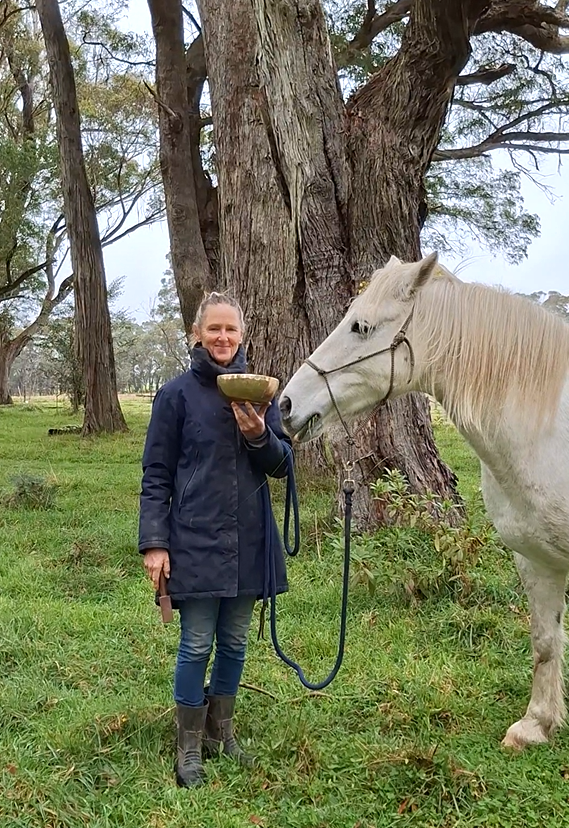
We work on the ground, alongside the herd, on 106 acres that does a good deal of the holding by itself. There is no assessment and nothing to prepare. You are not asked to explain yourself, or to arrive with the story already organised.
That last part matters more than it sounds. Horses do not respond to the version of you that you present. They respond to what is actually happening in your body, which is often something quite different, and often something you had not noticed. They are not interested in whether you have been useful today.
We go at whatever pace your body sets. You can stop at any point. Nothing has to be reached.
If you would like to understand more about the herd and how they participate, healing with horses explains it properly. And if you would simply like to talk it through first, that is often the right place to start.
If this is sitting heavily right now
Please be gentle with yourself after reading this.
Noticing a pattern can bring up more than expected, and there is no need to carry that alone. If things feel heavy, Lifeline is available any time on 13 11 14, and Beyond Blue on 1300 22 4636. Your GP or a mental health professional is a good place to begin too.
The work I do sits alongside that kind of support. It is not a replacement for it, and I would never suggest otherwise.
Frequently asked questions
What is the root cause of not feeling good enough?
For most people it traces back to conclusions drawn in childhood about who they needed to be in order to stay safely connected to the people around them. Those conclusions become expectations that shape how later experience is read. The feeling is usually the residue of that, rather than an accurate assessment of your worth.
What does it mean when you feel like you’re not good enough?
Often it means a rule you learned early is still running. The rule made sense at the time and served a real purpose. It simply has not been updated since, because nothing has ever prompted it to be.
Why do I not feel good enough when nothing bad happened to me?
Because it is not only what happened that shapes us, it is also what was consistently missing. Attunement, repair after conflict, being asked and then actually listened to. The absence of those things leaves no memory of an event, which is exactly why it slips past when you go looking for a cause.
Can you change a belief you learned as a child?
In short, yes. However, beliefs formed that early tend not to shift through reasoning alone. Change comes through somatic exploration, through allowing your body to talk to you at last. And what got stuck way back when, can be released, sometimes very quickly, and the belief changed..
Is feeling not good enough the same as low self-esteem?
They overlap, but they are not quite the same conversation. Self-esteem is usually about how you regard yourself now, and there is real value in tending to that, which The Self-Love Handbook explores. This article is about something earlier: where the regard was set in the first place.